Years ago I used to do a doctor roleplay with my third graders and it was super fun. But then our district gave us a unit framework and that vocabulary was moved down to kindergarten and I just couldn't make it work in the same way. So I was super excited to have the freedom to do kind of whatever I wanted with my sixth graders this past year. The doctor roleplay was back! And it got an upgrade because I saw my students every day!
Side note - Every student at my school takes a quarter each of Spanish, French, and Chinese the first three quarters and then fourth quarter they choose which one they want to continue on with through the rest of middle school.
In the first quarter I had them we learned basics like greetings, introductions, birthdays, where we lived, feelings, and numbers. More on that later because I also really like that unit! We started with a review since I hadn't seen some of them in months. But also because we would be using most of it in our roleplay later.
First up we learned body parts and we learned the alphabet so that we could spell our names.
We learned how to use the verb doler and practiced with a card game called Hola Doctor. I love to use this game with all kinds of vocab but in this case I had a ton of Me duele + body part cards and 1 or 2 Hola doctor cards. The students pass out all the cards and hold them face down (like in War.) They take turns asking ¿Qué te duele? The other player flips over their top card, read what hurts, and places it in the middle. They continue to ask and answer until someone flips over the Hola doctor card. When the doctor card is flipped the other player has to take ALL the cards in the middle pile. The person who gets rid of all their cards first is the winner.
I also used the same cards to play Quiz Quiz Trade. Students found a partner and asked them ¿Qué te duele? and then answered what was on their card. Then they switched. I walked around and encouraged them to act out what hurts and/or point to that body part. Needless to say I have several Oscar nominees amongst my sixth graders.
After we learned the Sana, sana colita de rana rhyme I added in the Hola doctor card into the Quiz Quiz Trade. If your partner had that card they would recite the rhyme over your hurt body part before they traded cards. That also was pretty hilarious. The Canticos song below was also a huge hit.
We also watched Mi Burro Enfermo Está and practiced different vocabulary for remedies. Again we played Quiz Quiz Trade.
Students then filled out a doctor visit dialogue and practiced in lines. One line stayed still while one shifted every time I rang the bell so they got to practice with multipe people. When I felt that they were ready we finally got out the doctor toys and took turns being sick, checking people in, and of course being doctors!
Students had to check in at the front of the room with a receptionist. Then they sat in the middle rows until a doctor was free. Our doctors sat in the back row and assessed the patients. When students were done they went back for a second, third, and sometimes a fourth opinion.
To make it work I waited until I knew the majority of students could handle the language they needed to do the roleplay. They also got to keep their notebooks on them and refer to them as needed. I also reminded them that if they were not speaking Spanish they would have to sit out. We never played more than 10 minutes or so because I didn't want them to get bored or slip into English. And it worked! We played over the course of a week so everyone had a turn to do each role and on my end of the year surveys most kids wrote they wished we had played more. Classroom management tip - always leave them wanting more!
Grab the worksheets and flashcards I used in this unit in my TPT store by clicking the picture below!
A few years back my district wrote a K-5 World Language curriculum and benchmark assessments. It was great to have some direction and all the teachers were teaching the same things but it also meant that a lot of my favorite projects got the ax because they didn't fit in where they used to. One of those was my Adios Monstruo class book I used to do in second grade (read more about it here).
Technically, in kindergarten we don't learn about body parts and emotions until the third unit after winter break BUT I have found that if I wait until then to introduce body parts they will not know them well enough for our benchmark assessment in March. So instead I introduce our body parts song on the first day of school and body parts are included in our classroom expectations (piernas cruzadas, manos dobladas, bocas cerradas, y ojos en la maestra.)
This year more than usual I've been getting into the Halloween vibe (maybe it's this awesome October weather we've been having in Kentucky?) So I decided to hit body parts harder at the end of our first unit to make monstruos. It's also given us a chance to practice colors and school supplies (which is one of the focuses of unit one.)
Learning Intention - I am learning about myself and my classroom so that I can follow directions and participate fullly in class.
Success Criteria -
I can recognize and list different colors.
I can list school supplies I need in class.
I can list parts of my body.
I can listen and follow directions to create a monstruo.
To start we watched Adios Monstruo. I paused it to review each body part and we practiced Tengo miedo and No tengo miedo.
In the next class we did a spin and draw activity. This page is nice because you can make it an independent activity OR you can do it in whole group. Since kindergarten students aren't quite ready for independent work AND staying in the target language, we did it in whole group using the website WheelOfNames.com (here is a link to mine already made.) The kids had a lot of fun as we drew our monstruos.
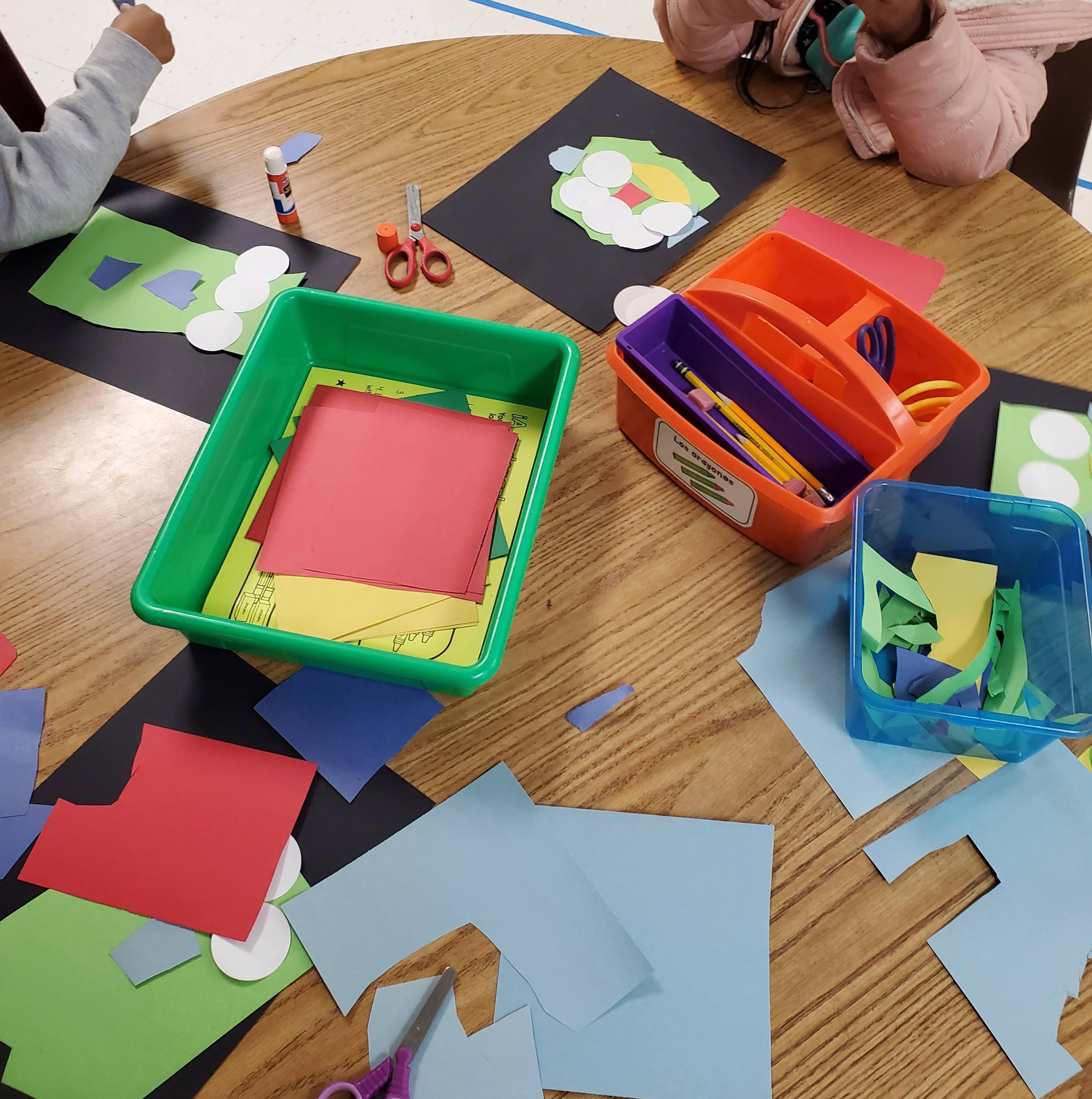
In the final two classes we've been making monstruos de papel. I give them the black paper and a smaller green paper to get them started. Then they make the mouth, nose, ears, any arms or legs with scrap paper that I put in the middle of the table. I also used the Ellison die cut machine to make circles for eyes.
Pro Tip - I went around with a silver sharpie marker and wrote their names on the back since most of their names are still hard to read this time of year and because the black paper made it hard to see them.
In the last class, we use marker to add deatils and then we cut and paste our labels on. This is not your cutsie social media perfect project where they all come out the same, but each kid got to make it their own way and I absolutely love how they turned out!
Because we had been practicing body parts from the beginning of the year as well as colors and supplies I was able to stay 90% in the target language. I modeled for them how to cut and glue and then went around and narrated what they were doing in Spanish. While they're working is also a good time to ask them in Spanish about what colors are they using, what body part are they gluing down, etc.
My 3rd graders are a tough bunch. It is often difficult to get them to stay on task. I noticed that when we did Ricitos de Oro y los Tres Osos that they didn't get into the choral reading as much as my second graders did. I wanted to make sure everyone was reading and actively participating so I let them just listen and watch while we did it in a big group. Then I distributed scripts and let them read and perform it on their own in small groups.
The hook was that after practicing each small group would perform for the class. The best class performers would then be our actors and actresses for a special performance for the 1st graders (who had just finished studying body parts so this would be a great review.) While this did lead to some fights over who read which part, it also had them working hard to read it well, with fluency and emotion, rather than just sitting there and barely mouthing the words like they had with the Tres Osos script.
Our actors performing for 1st grade
The kids who didn't get a speaking part for the big performance still had work to do. Every student made a program for the first graders with one of the characters from the play with body parts labeled. Several girls worked on the scenery during recess and after school. We also had ushers, people to pass out programs and snacks, custodians to clean up, an announcer to welcome the 1st graders, and basically any other small task I could give kids so that everyone was involved.
Every 3rd grader designed a program
It was a HUGE success. The first grade teachers raved about how well the kids read and their students loved it. One first grade student told me "Estoy bien. Estoy dos biens" which was her cute novice way of saying two thumbs up. And the 3rd graders had a blast. It took some extra coordination between me and the classroom teachers but it was well worth it.
The 1st graders loved getting a snack, program, & watching the play.
Get your copy of the Caperucita Roja Readers Theater HERE!
A big shout out to my colleague Alfonso de Torres Núñez who originally gave me the idea of doing readers theater and performances. Have you used readers theater in your classes? Share in the comments below or on Twitter using the hashtag #earlylang!
Last week I got to attend a week-long PD with my music teacher. The Kentucky Center for the Arts sponsors these academies in the summer, targeted at how to integrate the arts into other subjects in the curriculum. Music Teacher (MT) and I attended the academy on how to integrate World Languages and the Arts.
The art we were specifically working on was the music and dance of flamenco. MT learned some basic Spanish phrases that she can use in her class daily and I learned about the dance and music standards that I can be teaching in my class. We also spent the entire week learning a flamenco choreography that we performed on the last day for the French & German language and arts teachers.
The best part of the week? We came away with a unit almost completely planned out that we will use for Hispanic Heritage Month! We still need to pick out music but we decided that for the final product (aka summative assessment) our 3-5 students will perform for K-2 students a short flamenco dance that they themselves will create - creating and performing are part of the Arts standards! The K-2 students will watch and respond with jaleos (those words people yell out while watching flamenco dancers) - responding to art is another Arts standard!
I can statements for the unit:
I can recognize and understand direction and dance words for flamenco - adelante, atrás, arriba, abajo, palmas, golpes.
I can identify locomotor and non-locomotor movements in dance.
I can watch and critique a flamenco performance using Spanish jaleos - olé, agua, eso (K-5)
I can create and perform a short flamenco dance using locomotor and non-locomotor movements. (3-5)
In addition to the integration across the music classroom and the Spanish classrom, we will ask our librarian to read books about the history of flamenco to give the students the background knowledge as well as provide videos and writing assignments to the classroom teachers. We're hoping the Art teacher will work with the kids to create a cave tablao (where gyspies traditionally performed flamenco) and some evening art to set the scene and our STEM lab teacher will bring it in during her unit on sound waves.
We're also hoping to have all of this learning culminate in a family night with dancing, music, and tapas.
An integrated unit that answers my questions about what to do for Hispanic Heritage Month - not a bad deal. And we got paid $500 for the week. Oh, and they paid for us to go see Carmen at the Cincinnati Opera last month. The only bad thing was that MT couldn't stay overnight so we drove the 1.5 hours to Eastern Kentucky every day. If you are a teacher in Kentucky I highly recommend looking into The Kentucky Center for the Arts Academies for next summer.
This year my fifth graders have been participating in a program called Books As Bridges, which is part of the local charity The International Book Project. So far we've sent one letter to our pen pals in Panama and we've received letters. Last week, a representative from Books As Bridges stopped by school and did a cultural lesson. She showed pictures and talked about the geography, government, popular music and sports, and types of folk art. Then the students got to make a small piece of Mola art and tried some Gallo Pinto (that I had made) and Tres Leches cake (that our visitor had made.)
I was so worried about this big group lesson. We had all 120+ 5th graders in the library, listening to an unknown speaker and trying to do an art project in the floor. But it really turned out very well! The other Specials teachers I work with are amazing and stuck around and helped pass out paper, scissors, glue and even clean up afterwards. And the kids were really well-behaved and seemed to really enjoy it.
I even got a lady from our PR office to come and write an article about the lesson. You can read all about at this link here.
The students wrote a second letter leading up to the cultural lesson, which we will be sending along with our cultural package. Then in April we will do our service learning project - a book drive.
I recently read a post from blogger LoveTeach about how to spice up your teaching with zero effort. Her suggestion to teach with a fake British accent reminded me just how often I use funny voices in my classes. You just can't underestimate the power of the funny voices.
My funny voices started in Japan. I wanted my students to practice questions and answers in English. Since I spoke little to no Japanese I had to act out what I wanted them to do. They also happened to sit boy/girl/boy/girl there so when I acted out the students having the conversation with the person next to them one naturally had a very deep voice and the other a very high voice. One day I acted it out without the voices and I got a very upset little 3rd grader who said, "sensei, sensei blah blah blah" which I translated as "Teacher, where are the silly voices?"
I use the same strategy in my Spanish classes when I want the kids to practice questions and answers during our Enseña period. And since we´ve started doing descriptions in 4th and 5th grade they have become invaluable when learning that gender agreement in our ajectives - Yo soy delgada said in a high pitched voice versus Yo soy delgado said in a deep voice. Do the students think I´m crazy? Yes. Are they having fun? Yes. Are they learning the difference between femenine and masculine adjectives? Yes.
Funny voices are also great for anything that require repetition. So when I'm introducing new vocabulary we say it quiet, loud, high-pitched, low-pitched, angry, sad, like robots etc. Let the students give you ideas. This past week in my after school enrichment program we sang Cabeza, Brazos, Piernas, Pies (or Head, Shoulders, Knees and Toes) many many different ways, my favorite being as old men with canes and Tyrannosaurus Rexes, both student suggestions. As dinosaurs we roared after each verse and as old men we groaned when we couldn't reach our toes. I was almost in tears from laughing by the end.
Do you use funny voices in your classes? How and when? Share in the comments below!
So we're still out of school for sub-zero temperatures and I'm starting to worry we might be out again tomorrow because the forecast only has it warming up slightly. But since I'm at home in my pajamas eating peanut butter out of the jar let me catch you up on our pen pal project with the local organization Books as Bridges, part of the International Book Project.
Originally, we thought we were getting pen pals in Ecuador but it turns out they are in Panama, but since they speak Spanish and are learning English I don't mind! Our teacher contact is actually a Peace Corps volunteer working with the English teachers at this school.
For our first letter my students wrote 3 paragraphs - an intro paragraph in Spanish with phrases like "Me llamo _____", "Tengo ___ años" and "Yo vivo en Lexington." The second paragraph they wrote either in Spanish or English about their likes and dislikes. Our third paragraph was in English talking about Thanksgiving.
Our first letters from our friends arrived about the same time we were sending our first letters. They were more profiles than anything else and it looks like some of them were written last spring so I wonder how long this school has been waiting for pen pals. Most of the letters were written in English, although a few did have some Spanish. So my students should have had no problem reading them, right? Wrong! They were written in cursive, something we just don't teach here in the States anymore. So many of my kids struggled to read their letters.
To combat this problem I put them into groups and passed out their letters. Together they were supposed to help each other read and share aloud about their new friends. Then I went around the room and read the letters for the students who were having trouble. In the last few minutes we shared with the class 1 or 2 things about our new pen pals.
The students were very excited to read their letters, although I did have a few ask me if they were real (this being a consequence of our performance based summative assessments being video messages to a not-so-real girl named Maria who was moving from Spain to Lexington...oops!)
The next part of the project will be another letter and a cultural package to teach our new pen pals about life in Kentucky. Ideas the students have thrown out already include menus from Kentucky Fried Chicken, bottles of Ale8, and basketball schedules for UK and U of L, as well as pictures of our school. We'll also have a cultural lesson on Panama from a representative from The International Book Project. More updates to come as we continue!
I've been looking for ways to connect with classrooms in my target language classrooms and have struggled to find a way to do it easily with my students' novice low-mid Spanish level and coordinate it for as many students as I have (670+). A solution finally presented itself with the Books as Bridges program.
Books as Bridges a local program that is part of the larger non-profit the International Book Project that sends books to developing countries. In the Books as Bridges program students write three letters to pen pals in a developing country, send a cultural package about what life is like here in Kentucky and they do a community service project somehow related to their pen pals. That all sounded awesome to me so I talked to our fifth grade team and they were also interested so I signed us up.
To make this relevant to our Spanish study we requested a partner classroom in South America that was studying English. The immersion school in our county has participated before in the past with other elementary schools in Latin America but I felt that my students' level of Spanish wasn't really at a point where we could be writing letters completely in the target language. But if we could write a small introduction in Spanish and then finish our letters in English that could work. A partner classroom that was learning English could do the same thing but in reverse - intro in English, rest of the letter in Spanish. My students are much better at reading and negotiating meaning than they are at producing now. Anything they couldn't figure out I could translate for them.
They told us that they had done that before so it shouldn't be a problem. However, apparently it's taking longer than usual. We got a late start anyway because I didn't find out about the program until past the official application date but they let us in. Now the contacts in Ecuador are being slow to answer emails. The back-up plan will be a partner classroom in Africa, which while it will still be cool to have pen pals and do a service learning project it will negate the whole reason I'm running it.
In the meantime we had a pen pal prep session and all the students are excited. Hope they let us know soon about our partner classroom so I have answers for my students who are beginning to pepper me with questions every time they see me. Fingers crossed!