A staple of every Spanish I class is hobbies and sports and we just started this unit with eighth grade.
This is actually a mini-unit that is a review of last year's content but the challenge is to expand on what we learned last year for students who had me in 7th grade but keep it accessible enough for students who are new to the school and/or didn't have me last year. The solution? Lots of comprehensible input using authentic resources!
First, students filled in a picture dictionary of different after school activities.
I love to have students make picture dictionaries to put in their Spanish notebooks. This helps us to avoid translation and I think it helps them to remember if they have to write it down rather than me just giving them a vocabulary list.
I love an authentic resource - it lets students see the language out in the real world and the right one can stimulate good conversations (in the target language of course!) My 7th graders are in the middle of their school unit and we are comparing and contrasting school schedules and talking about our own classes. Here are some of the schedules we're looking at.
Years ago I used to do a doctor roleplay with my third graders and it was super fun. But then our district gave us a unit framework and that vocabulary was moved down to kindergarten and I just couldn't make it work in the same way. So I was super excited to have the freedom to do kind of whatever I wanted with my sixth graders this past year. The doctor roleplay was back! And it got an upgrade because I saw my students every day!
Side note - Every student at my school takes a quarter each of Spanish, French, and Chinese the first three quarters and then fourth quarter they choose which one they want to continue on with through the rest of middle school.
In the first quarter I had them we learned basics like greetings, introductions, birthdays, where we lived, feelings, and numbers. More on that later because I also really like that unit! We started with a review since I hadn't seen some of them in months. But also because we would be using most of it in our roleplay later.
First up we learned body parts and we learned the alphabet so that we could spell our names.
We learned how to use the verb doler and practiced with a card game called Hola Doctor. I love to use this game with all kinds of vocab but in this case I had a ton of Me duele + body part cards and 1 or 2 Hola doctor cards. The students pass out all the cards and hold them face down (like in War.) They take turns asking ¿Qué te duele? The other player flips over their top card, read what hurts, and places it in the middle. They continue to ask and answer until someone flips over the Hola doctor card. When the doctor card is flipped the other player has to take ALL the cards in the middle pile. The person who gets rid of all their cards first is the winner.
I also used the same cards to play Quiz Quiz Trade. Students found a partner and asked them ¿Qué te duele? and then answered what was on their card. Then they switched. I walked around and encouraged them to act out what hurts and/or point to that body part. Needless to say I have several Oscar nominees amongst my sixth graders.
After we learned the Sana, sana colita de rana rhyme I added in the Hola doctor card into the Quiz Quiz Trade. If your partner had that card they would recite the rhyme over your hurt body part before they traded cards. That also was pretty hilarious. The Canticos song below was also a huge hit.
We also watched Mi Burro Enfermo Está and practiced different vocabulary for remedies. Again we played Quiz Quiz Trade.
Students then filled out a doctor visit dialogue and practiced in lines. One line stayed still while one shifted every time I rang the bell so they got to practice with multipe people. When I felt that they were ready we finally got out the doctor toys and took turns being sick, checking people in, and of course being doctors!
Students had to check in at the front of the room with a receptionist. Then they sat in the middle rows until a doctor was free. Our doctors sat in the back row and assessed the patients. When students were done they went back for a second, third, and sometimes a fourth opinion.
To make it work I waited until I knew the majority of students could handle the language they needed to do the roleplay. They also got to keep their notebooks on them and refer to them as needed. I also reminded them that if they were not speaking Spanish they would have to sit out. We never played more than 10 minutes or so because I didn't want them to get bored or slip into English. And it worked! We played over the course of a week so everyone had a turn to do each role and on my end of the year surveys most kids wrote they wished we had played more. Classroom management tip - always leave them wanting more!
Grab the worksheets and flashcards I used in this unit in my TPT store by clicking the picture below!
My fourth graders recently finished a unit on shopping and it was super fun! I haven't done this unit in several years because I seem to run out of time and I've focused on other things (mainly things I knew would be on the district benchmark assessment) but we revamped our district K-5 curriculum this fall and I brought this unit back with a bang!
Be sure to read to the end for a FREE RESOURCE!
I started by introducing different currencies by posting a link to a Thinglink. Students clicked on the arrows to see images of the difference money. I also included a link to this currency conversion site so that students could play around with different numbers.
I also added money visuals to my wall map. Students of all grades loved looking at what $5 around the world looked like.
My fourth grade students have already been using numbers during our calendar & weather time to talk about the date and the day's temperature but we practiced some more with a guessing game. This simple game was seriously one of their favorite things to play and it got super noisy!
Then we watched an Edpuzzle video and answered some questions about the different prices that we heard.
They also read real school supply lists from different Spanish speaking countries and put the items they needed into their shopping carts that I created on jamboard. Later they took turns telling a partner what they needed and the partner put those items in their cart.
We also started class with a warm-up where they looked at shopping ads and practiced asking ¿Cuánto cuesta? and answering with the price.
This was also a great way to review some of their math standards like rounding.
They worked again with a partner to create prices for different items in their own shops - practicing ¿Cuánto cuesta? and numbers again. Then I had them walk around and ask each other how much different items cost. Whoever had the best (ie. lowest) price won a point. This turned out to be hilarious because I hadn't told them we were going to play this game so some of them had absolutely outrageous prices.
We didn't have time to do a full on shopping roleplay game but for their interactive notebooks, they made these cute shopping bags. On the outside they wrote a shopping list and on the inside they drew the items and wrote the prices. Overall, it was a high interest and high engagement unit.
What do you include in your shopping units? Share in the comments below!
In second grade we have been learning about making healthy food choices. If you follow me on Instagram you will have seen some fun activities we've been doing as wrap up this unit.
In the past I have struggled somewhat with this unit because there are so many different ways to look at this. Do you use my plate from myplate.gov? But then you have to teach food groups and those aren't really high frequency words I can spiral back in later. What about the food pyramid? Those are better but outdated.
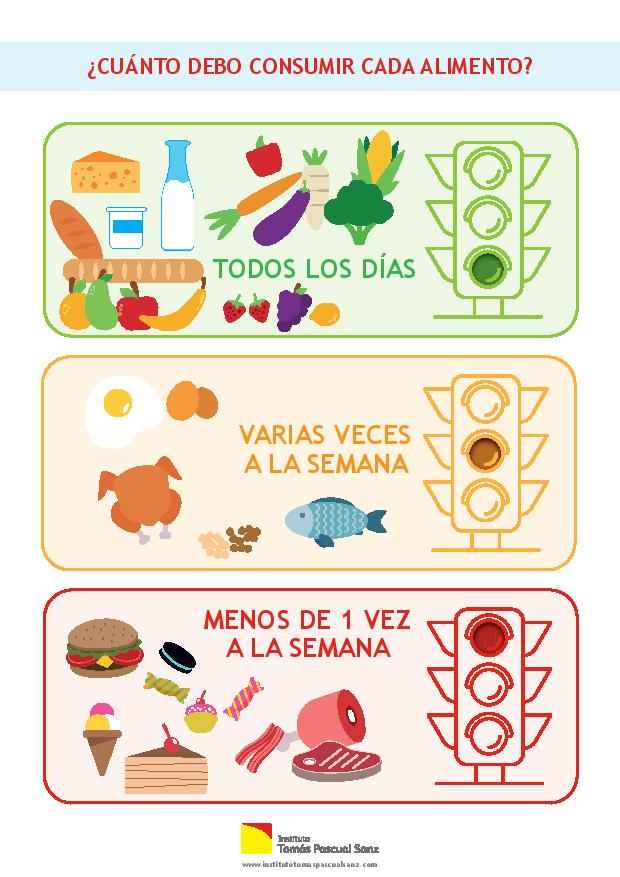
I finally stumbled upon stoplight posters for nutritional choices and it was an AHA moment! Students can review their colors and use frequency words! Once I knew what to search for, I found some really great resources. Like really really good!
I started with this poster to introduce the idea of comida saludable y comida chatarra.
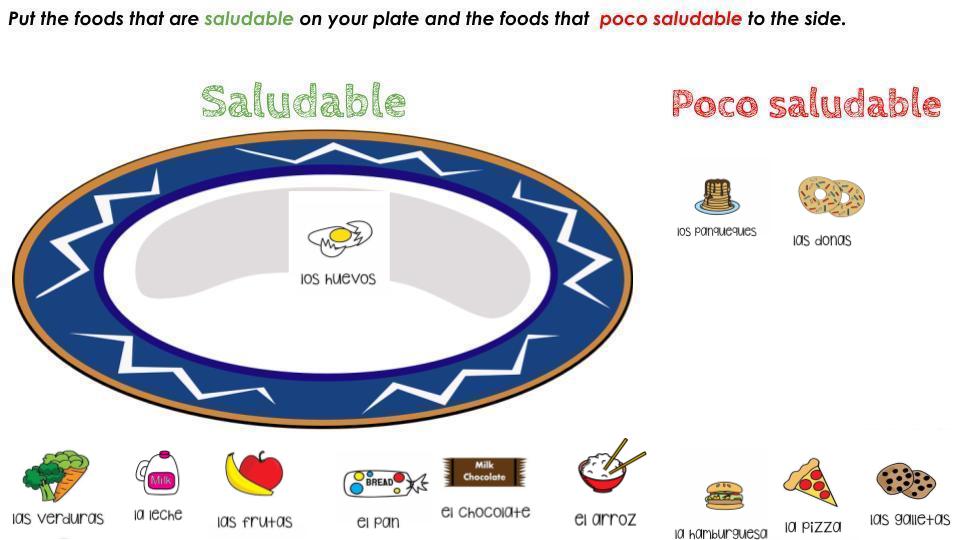
We sorted into two categories to start because that was easier for this age group (I added in the third category later). We sorted first as a group and then in pairs in a google slide I had assigned via Google Classroom.
Our whole group sort
Students then sorted in pairs or indiviudally
Once they felt comfortable with sorting them into saludable y poco saludable we moved onto the stoplight poster. Taking a strategy from the book Common Ground: Second Language Acquisition Theory Goes to the Classroom, in the first class we made predictions as a class about where different foods would go on the poster. To do this I just cropped the picture and put in my food pics to move around. In the next class we checked our predictions against the actual poster. Click here to see the full resource from the CDC.
We also played this interactive game! I had students whisper to their partner where they thought it should go and then one student came up and pushed the button. Later, I put the link in Google Classroom so they could play on their own. This one was a BIG hit with all my classes. Click here to go to the game.
All of these activities were woven in with talking about foods around the world and talking about what foods we like and dislike. After students finished their writing page about what foods they liked they could choose to make their own stoplight poster on paper, with my play food, or play the stoplight game on their chromebooks. I'm hoping to take our photos and papers and make a display in our cafeteria.
I received a huge gift of play food this summer and my students had a blast sorting and labeling it!
I have really enjoyed this unit and so have my students. The best part is you can really do this at any age and it fits well into both IB and AP themes. If I had more time or older students I would have loved to compare posters from different countries. Or even make a poster for someone who is vegetarian or gluten free, etc.
Our animal for Chapter Two is el mono with an emphasis on the verbs comer (eat) and saltar (jump). This year I have been experimenting with more TPRSish storytelling techniques. I´ve used 5 Little Monkeys Jumping on the Bed before but this year I wanted to make sure that the students were not just learning that monkey is mono but also learning some high frequency phrases.
I started with this basic video that focuses on the structure There is _____. Some kids got frustrated at how slow it went but I knew it was working when a fifth grade boy told me in the car rider line one afternoon, Hay un mono. ¿Dónde? I asked him. Then he pointed to himself and said it again.
After watching this video I showed them another video - this time with real monkeys. With this video I turn off the sound and together we describe what we see. Hay un mono. Hay dos monos. El mono come. El mono salta. One student told me, "Estoy triste" when the monkey steals and eats a bird egg. The students generally react with excitement when watching the real animals. I've used similar videos when talking about other animals. (One thing I will do better next time is make sure that the students know these monkeys live in Costa Rica. We can find it on the map and ask if Hay monos en Kentucky? for a quick comparison.)
In the next class I told them the story of the Cinco Monitos using the storytelling props from Kizclub.com. I start out by pulling out one monkey and questioning students about how many monkeys there are. At some point I tell them NO, no hay un mono. Hay dos monos and I pull out the second monkey. Then repeat until I surprise them with the third. And so forth up to five. Some classes get smart and will say the next number before I can while other classes wait for me to spring it on them. Below is how I ask the questions during the story. I have
the two sentences. Hay ___ monos, Los monos saltan en la cama, and No más monos saltando en la cama up on
the board so students can easily answer my questions. I ask them to answer chorally and also individually, mixing it up so they have to pay attention.
¿Cuántos monos hay? Hay cinco monos. ¿Hay 2 monos? No no hay 2 monos. Hay cinco monos. Los
monos saltan. Los monos saltan en la cama. ¿Los monos bailan el
flamenco? No, los monos saltan en la cama. ¿Los monos comen las bananas?
No, los monos saltan en la cama.
Mamá mono llama al doctor. El doctor dice, "¡No más monos saltando en la cama!"
¿Hay cinco monos? No, no hay cinco monos. Hay cuatro monos. ¿Cuántos monos hay? etc. etc.
Even my fifth graders are enjoying listening to this story. I've had several classes groan when I said it was time to go. They especially like to yell the answers when I say the wrong thing. There's something about correcting the teacher that gets them no matter what age they are.
High frequency phrases to focus on:
Hay ____.
El doctor dice _____.
No más ______.
After finishing the story we watched the video and sing along. The way I tell the story doesn't match the song exactly but it´s close enough that the students understand and can sing along to almost all of it. If you have a rowdy class that needs to get some energy out, I highly recommend jumping around to 5 Monitos. It works wonders
So that's what we've been doing in Spanish class! What have you been up to? How do you teach high frequency phrases? Do you use storytelling or TPRS? I'd love to compare notes. Share in the comments below or on Twitter using the hashtag #earlylang
After spending a month in Spain this summer and seeing SOOO much great art at the Museu Picasso and the Fundació Joan Miró in Barcelona as well as the Prado and Reina Sofia in Madrid, I decided I needed to add more art to my curriculum.
Works by Joan Miró in Barcelona
THIS SECTION WAS UPDATED IN 2019
I always start the year off with kindergarten with the learning targets of "I can identify 4 colors in a Joan Miró painting," "I can list 4 school supplies I use in class," and "I can introduce myself."
First we learned the colors two at a time. We practiced by playing the Color Point game (I say ¿Dónde está rojo? and students have to find it in the room and point.) We practiced the school supplies with a chant and by doing our Flotan o No Flotan activity.
We also watched the Calico Spanish video Colores Colores. They love this video and it gets them used to hearing the phrase Me gusta.
Once we had all the colors learned we looked at el arte. I showed students a picture of Joan Miró and we described the colors that we saw and if we liked the picture or not. We also learned that "Joan Miró era un artista. ¡Yo soy un artista!" This tied into our other learning target of introducing ourselves. They turned and introduced themselves to a partner and we played Hand Up, Pair Up.
Finally, we created our own Miró inspired arte. The first class we used los papeles, un lápiz, y los crayones. In the second class we added our names and a few stars with sharpie markers.
I think the results came out really well. And the best part is that students not only know their colors and how to introduce themselves but they know a little more of the culture as well.
Do you teach works of art in your classes? I'd love to hear from you and get ideas on how to use more art in my classroom! Share in the comments below or on Twitter using the hashtag #earlylang.
I have been looking for a way to monitor my students' participation and progress in class but have never found anything that hasn't completely overwhelmed me (even when I was just trying to focus on 4th & 5th grade - who get letter grades in Specials classes.) Last spring at SCOLT, I met Nadine Jacobsen-McLean, former elementary school Spanish teacher and current president of NNELL - National Network of Early Language Learners. She explained how she gave grades to ALL 600+ kindergarteners-5th graders every 9 weeks by using ¡Sí, se puede! bubbles. The beauty of the system is that it can be tailored a hundred different ways depending on your needs.
I use this picture as my binder cover.
So how does it work? I have a binder with class lists with 10 bubbles by each kid's name. When I hear them using Spanish relating to our I can statements or I call on them in class I tell them Si se puede and they go up to the front of the room and color in a bubble by their name. I LOVE it for several reasons. 1. THEY are the ones doing the record keeping for me. I don't have to stop, find their name, or write anything.
2. They love getting up in front of everyone and coloring in their bubble. Kids who used to never raise their hands are now straining to be called on. And the few who aren't are getting used to be called on anyway because... 3. No one falls through the crack because I can quickly scan the sheet to see who hasn't talked in awhile and I make to sure to call on them.
A screenshot of my Si, se puede sheets. I keep them in a binder at the front of the class.
Right now I'm just using it for participation and they can use any color they want but you can have them use specific colors for different things (Si se puede con verde for meets expectations, con azul for exceeding expectations, and con amarillo for not quite there but trying.) Or you could use colors to distinguish I cans (con amarillo for I can introduce myself, con verde for I can talk about my feelings, etc.) I've told the students that they will get a small treat when they reach their 10 bubbles, which will be a Hershey kiss so that I don't break the bank. I have started the year with just 3rd-5th to see how it would go but it's been so easy for both me and the students that I am going to add the rest of the grades very soon (although I'm hoping the littler ones won't need the treat as a bribe and the bubbles will be enough of a reward.)
How do you keep track of your students' participation and progress? Share in the comments below or on Twitter with the hashtag #earlylang! UPDATE! I've moved to tracking students performance levels in class. Yellow means Novice Low. Green is Novice Mid. And blue is Novice High. I tell students they should have a few yellow, lots of green, and a few blues since Novice Mid is our target. I've had students tell me they wanted to get blue and ask how they can get there. Other students are encouraged that even though they are making mistakes or need help they can still get a yellow bubble for trying.
I started out the school year with a story in 2nd grade this year - Caperucita Roja - to review the structures we learned last year using the Calico Spanish curriculum. While I love Calico, I added this before we jumped back in since students tend to forget so much over the summer. Caperucita Roja has so many opportunities to practice basic structures in the language and the kids love it because it´s familiar.
Target Structures (Things they've seen before are bolded):
¿Cómo te llamas? Me llamo ______. ¿Cómo estás? Tengo hambre. Estoy triste. Tengo miedo. Estoy enferma.
Mi abuela está enferma. ¿Por qué?
Necesito ir (a la casa de mi abuela). Necesitas venir aquí. Necesitas abrir la puerta. ¡Yo veo (body part) grande!
Necesito mirar/escuchar/comer.
Gracias/De nada. I told the story first using props from www.kizclub.com. I never tell the students what story they are listening to is one they already know in English because it's so much fun to listen to them as they figure it out. Before we start we repeat the expectations - Necesito mirar. Necesito escuchar. Necesito participar. Students participate by repeating the target structures with me as I tell them the story.
After hearing the story in one or two classes, I showed them a powerpoint with the same target structures. While I had individual students come up and act out certain parts, everyone read together (so that we ALL got practice.) My actors held their masks and had to look sad, sick, hungry, and ferocious. :-D At the end we discussed who were the characters, what was the problem in the story, and what was the solution. I let students answer in English (unless they were heritage speakers and then I insisted on Spanish) but we read the answer together in Spanish.
After doing the readers' theater version twice, I handed out envelopes with introductions to each characters. Students had to work together with a partner to match the introductions to the right character. Our staff recently went through Kagan training so we are all trying to use Kagan structures. I told the kids to work together and match them up AND THEN read them to each other using Rally Robin. But my second class didn't quite understand and instead one student would read a sentence and the other student had to find the picture and match it and then they switched - making it more like Rally Coach and a much better way to ensure everyone was engaged, reading AND listening. Don't you love it when students think of a better way to do something? Once they finished they got a worksheet with Sr. Lobo that they had to label the body parts.
We had to move on quickly to make sure we had enough time to get our Journey North butterflies ready in time but our summative assessment for this unit will be a reading & matching exercise similar to the activity they already did. Here's a great video (and authentic resource!) to use too. I have my novices listen for key words and it works great for differentiating for my heritage speakers.
Do you teach any fairy tales? What resources do you use? Share in the comments below or on Twitter using the hashtag #earlylang!
Fellow Spanish teacher, Emily, here in Lexington recently emailed me with a great game for kindergarten.
I tried a new game this year and the kids have really loved it and we were able to speak in Spanish for the entire game. Thought I’d share. It’s so simple, but great.
Have students in a circle/desks/you could even do this in small groups once they get the hang of it.
Call on someone by asking ¿Cómo te llamas? They answer with Me llamo ___.
Whole class tell them Adios ____.
Cover them with a bandana or I used a Spanish flag.
Whole class asks ¿Dónde está? ¿Dónde está? Until student pulls the flag off and the class shouts ¡Hola ____!
I demonstrated with my stuffed animal and myself so they wouldn’t feel silly about covering their heads. It is so simple, but I’m telling you their belly laughs are precious and they were all speaking in Spanish and loving it.
I played it this week with my kindergarten classes and like Emily's students we had a great time.
I have never done a really good job of explaining proficiency levels to my students. One of my goals this year was to make sure my kiddos understood the process of learning a language. I didn't want any of them to get frustrated because they couldn't speak Spanish fluently after a month.
The Chinese and Japanese teachers in our district have these awesome illustrations where students "climb" the Great Wall of China or Mount Fuji from novice low up to intermediate. But us Spanish teachers didn't have anything nearly as cool and culturally relevant. So this summer I decided to make a proficiency level pyramid using Chichen Izta in Mexico.
I introduced it to my fourth and fifth grade this past week and they loved it! I printed one large one in color to put on my bulletin board and each student got a half sheet in black and white to keep in their folders. I explained that even in English we aren't born speaking in complete sentences. We are at the top of the pyramid in English but at the bottom in Spanish working our way up.
We also looked at pictures of the real Chichen Itza and reviewed the taco rubric from Mundo de Pepita. Both the pyramid and the taco rubric really gave them good images to associate with their learning in Spanish class. And I know it was working when they asked me how they could get to intermediate. Do you talk about proficiency levels with your students? How do you explain them? Share in the comments below or on Twitter using the hashtag #earlylang!
I've been in school a month now and we're finally getting rolling into some content and switching over to Spanish. In that time I've been doing lots of administrative tasks and getting my new room up and going. Here are a few of the freebie products I've found and used in the last month.Just click on the pictures and follow the link to Teachers Pay Teachers.
Free Resources!!!
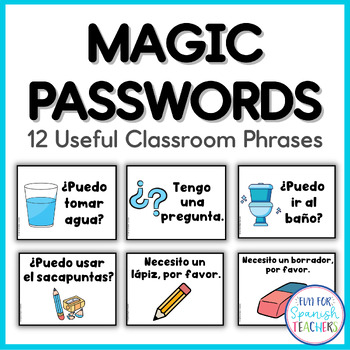
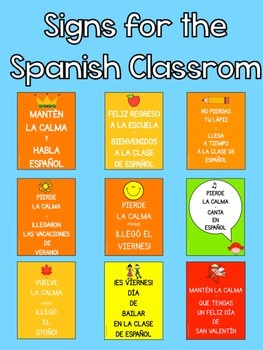
Magic Passwords or Survival Phrases with adorable pictures from Fun for Spanish Teachers.
I haven't printed these out because I already have a board for new phrases (two Day of the Dead skeletons talking to each other) but I plan on using many of the phrases in this pack. If you need ideas for a bulletin board to last all year this is a great resource.
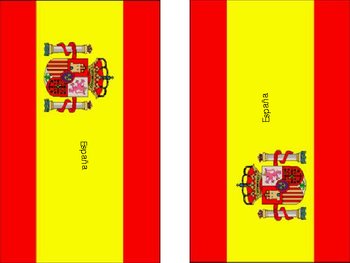
Foldable flags from Spanish speaking countries to decorate your room.
My kids love these cute rhymes and we use them in our beginning of class routine.
Another freebie from Fun for Spanish Teachers. I have the Puedo ir al bano sign front and center. If students ask me in English the answer is no. If they ask in Spanish I generally say yes (or yes in just a minute because I've found most of them forget a few minutes later.)
Enjoy and be sure to check out these ladies paid products as well!
For Hispanic Heritage Month I am planning a collaborative unit focusing on Flamenco, integrating the Arts & Humanities standards with my World Language standards. At the end of the month we will have a Family Night where students can bring their families in and show off what they've learned. Below are some of the resources I'll be using and sharing with my team members and classroom teachers. If you know of any other Flamenco resources please share!
http://youtu.be/y3D2s7DyS0U Sesame Street - a video counting to 9. Unfortunately they count in English but the music and dancing is flamenco.
http://youtu.be/6-Fy124VWCY Toy Story - Buzz and Jessie dance flamenco. Would be great for introducing students to flamenco and then showing the more authentic videos after.
There aren't a lot of books out there for flamenco but here are a few good options.
¡Olé flamenco! This is a great resource for older students. My kids will be doing a research project in Library class and this is one book I will have available for them.
El fandango de Lola This book comes in English and Spanish with a CD. Spanish Playground has some great resources to go along with the Spanish version here.
Spain booklet A great booklet your students can color and read from Teacher Pay Teachers. It has 11 pages with facts about geography, flamenco, football, bullfighting, and the Conquistador. It's in English so I will probably share with my classroom teachers and let them decide if they want to use this resource or not.
Craft Ideas
I still need to talk to my Art teacher about how we might combine her standards with something flamenco related but here a few pages with ideas for flamenco crafts. These could be done with the classroom teachers as well.
How to make castanets These are cooler than the ones we made last year in Spanish Club with paper plates and pennies (although my kids loved their paper plate/penny castanets!)
No posts lately due to grad school and end of the year craziness combined and then the school year ended and I've spent the last week and a half taking some time to breathe and visiting friends and family out of town.
But now I'm back and working from my couch with Despierta America on in the background as I plan out next year. As I'm planning I'm using several documents to guide me:
ACTFL Can Do Statements: Most of my I can statements are direct quotes of this document (although a few are changed a little to fit my needs.)
JCPS World Language Frameworks and Curriculum Maps: Jefferson County just released their newly revised curriculum. I liked the documents they had before but these are even better because they have maps specifically for elementary school. They even suggest which vocabulary to teach with each unit. I won't use it exactly the way they have it outlined but it's a great jumping off point.
I also recently discovered that my own district had an elementary curriculum that I was supposed to be using but that no one had given me. I'm referencing that as well although it will also be revised this summer. There's no link since I had to have a friend email me her copy of it.
As I get more into things I will post what I hope my year will look like and how I plan my units. Until then please share in the comments what documents and curriculum you use to guide your unit planning.
I recently read a post from blogger LoveTeach about how to spice up your teaching with zero effort. Her suggestion to teach with a fake British accent reminded me just how often I use funny voices in my classes. You just can't underestimate the power of the funny voices.
My funny voices started in Japan. I wanted my students to practice questions and answers in English. Since I spoke little to no Japanese I had to act out what I wanted them to do. They also happened to sit boy/girl/boy/girl there so when I acted out the students having the conversation with the person next to them one naturally had a very deep voice and the other a very high voice. One day I acted it out without the voices and I got a very upset little 3rd grader who said, "sensei, sensei blah blah blah" which I translated as "Teacher, where are the silly voices?"
I use the same strategy in my Spanish classes when I want the kids to practice questions and answers during our Enseña period. And since we´ve started doing descriptions in 4th and 5th grade they have become invaluable when learning that gender agreement in our ajectives - Yo soy delgada said in a high pitched voice versus Yo soy delgado said in a deep voice. Do the students think I´m crazy? Yes. Are they having fun? Yes. Are they learning the difference between femenine and masculine adjectives? Yes.
Funny voices are also great for anything that require repetition. So when I'm introducing new vocabulary we say it quiet, loud, high-pitched, low-pitched, angry, sad, like robots etc. Let the students give you ideas. This past week in my after school enrichment program we sang Cabeza, Brazos, Piernas, Pies (or Head, Shoulders, Knees and Toes) many many different ways, my favorite being as old men with canes and Tyrannosaurus Rexes, both student suggestions. As dinosaurs we roared after each verse and as old men we groaned when we couldn't reach our toes. I was almost in tears from laughing by the end.
Do you use funny voices in your classes? How and when? Share in the comments below!

.png)


.png)


.jpg)
.jpg)

.jpg)


.jpg)


